

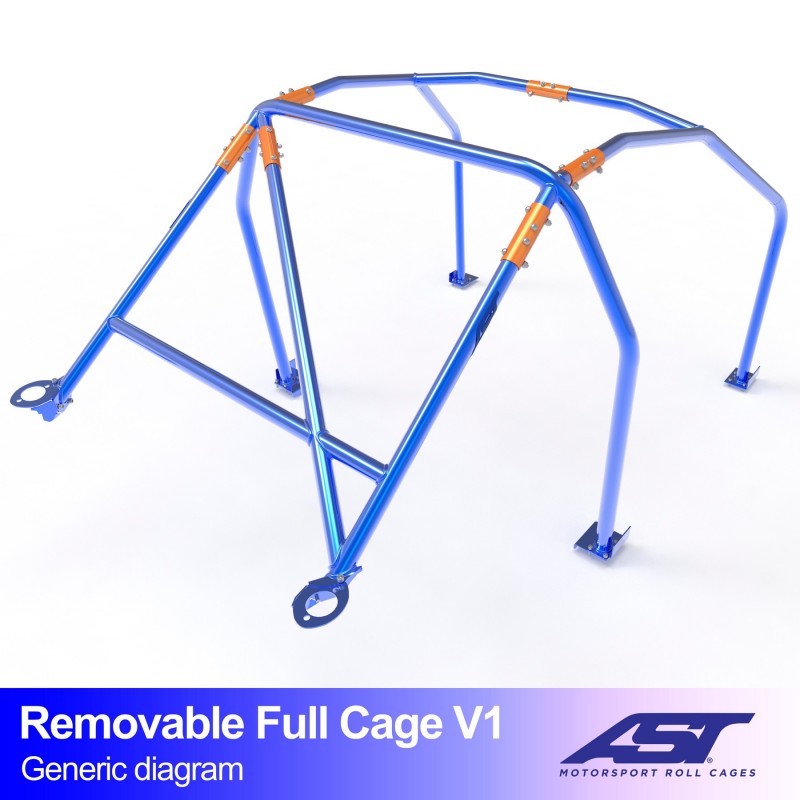
Can your E36 still be driven on public roads with a roll cage fitted, and what about the APK or the vehicle inspection? This article sets out what official sources say, and where you are better off checking in advance.
Short answer: When it comes to a roll cage and the APK or vehicle inspection, there is no simple yes or no. In the Netherlands we have not found any public RDW rule that deals specifically with a roll cage in a passenger car, but the RDW requires an individual approval if a structural modification invalidates the type approval. In Flanders, according to GOCA, you must declare every modification at the inspection, and the interior must not have any dangerous protrusions. If you want to keep your options open, choose a cage that can be taken out of the car again, such as the AST removable roll cage for the E36 coupé V2.
This article is an in-depth follow-up to our guide to the BMW E36 roll cage. We are not lawyers or inspectors: use it as preparation and, if in doubt, always ask the official body for a definitive answer.
Table of contents
Roll cage and APK in the Netherlands: what do we know?
The APK checks whether a car is safe and environmentally friendly enough for public roads. According to the RDW, the APK looks at the brakes, the suspension and the lighting, among other things. A roll cage is not mentioned separately in that general explanation.
We have not found any public RDW page that states specifically whether or not a roll cage is permitted in a passenger car. That does not mean anything goes. It means you need to check in advance how an inspector or the RDW will assess your particular situation.
When individual approval is required
The RDW does describe when a vehicle has to be approved again: if you modify the construction of a vehicle to the extent that its type approval lapses, the RDW has to approve the vehicle individually. Whether a roll cage in your E36 falls into that category depends on the cage and on how it is fitted.
A welded-in cage changes the bodyshell permanently. A removable cage leaves the bodyshell largely intact, apart from the reinforcement plates. So put your plans to the RDW before you have the cage fitted, and keep their answer with your car’s paperwork.
What an inspector may look at
Even without a specific roll cage rule, an inspector assesses the safety of the car. This covers things such as how the seats and seat belts are mounted, any loose or sharp parts in the interior and the condition of the bodyshell around the mounting points. A neat, well-finished installation makes the conversation at the APK test a good deal easier.
Bear in mind, too, that different inspectors may judge the same situation differently. What passes without comment at one garage may raise questions at another. That is exactly why a written answer from the RDW is so valuable: it gives you something concrete to fall back on. If you are going to a new APK test garage, tell them in advance that the car has a roll cage and bring your documents with you. That way you avoid the inspection unexpectedly dragging on, or having to come back for a re-test.
Inspection in Flanders: what GOCA says
In Flanders, the rules on vehicle modifications are described in more detail. GOCA Vlaanderen, the federation of vehicle inspection centres, explains that you may not simply modify your car without the manufacturer’s approval. The car tuning legislation sets out which modifications are allowed without the manufacturer’s permission.
A few of GOCA’s basic principles are especially relevant to a car with a roll cage:
- The interior must not have any dangerous projections or sharp edges that increase the risk of injury in a collision.
- The inside of the roof above or in front of the occupants must not have any dangerous projections or sharp edges pointing backwards or downwards.
- The backs of the seats must not have any dangerous projections or sharp edges.
A roll cage sits in the interior by definition, close to the roof and behind the seats. These rules therefore affect precisely the areas where a cage is fitted. Discuss your plans with your inspection station beforehand.
Report every modification
According to GOCA, you must report every new adaptation or modification to the inspection centre and present the necessary documents. After a modified car has been inspected, you receive a tuning report, which you must always keep with your inspection certificate.
For parts without European or UN approval, your inspection certificate remains valid if the inspection centre gives the modification final approval. If the centre definitively rejects the modification, the certificate is only valid for 15 days, according to GOCA.
Bucket seats in an E36 coupé or Compact
For an E36 coupé or Compact with a roll cage, another GOCA rule is also worth knowing. According to GOCA, a non-folding front seat in a two- or three-door vehicle is only permitted if the rear seat and its seat belts are removed and the rear seat anchorage points are permanently rendered unusable. Anyone fitting a bucket seat in a coupé or in the 3-door Compact therefore has to take this into account. The 4-door saloon and the 5-door Touring are not covered by this rule.
What a roll cage changes on public roads
On the track you wear a helmet; on public roads you do not. That changes the risks: in an accident, your head can strike a cage tube. This is why track day organisers such as RSZ Autosport already require cars with a roll cage to have a protective foam layer on the cage tube at head height for the driver and passenger.
For a car that is also driven on the road, that protection matters even more. Also think about getting in and out: a cage with door bars makes climbing in and out more awkward, especially for passengers who are not used to it.
Which cage is the most flexible for a road-registered car?
If your E36 is staying road-registered, flexibility is valuable. A cage that can come out of the car again gives you room to manoeuvre if the inspector, the insurer or your own plans call for something other than you expected.
| Type of AST cage | Can it be removed again? | Effect on the interior | Suitable for a road-registered car? |
|---|---|---|---|
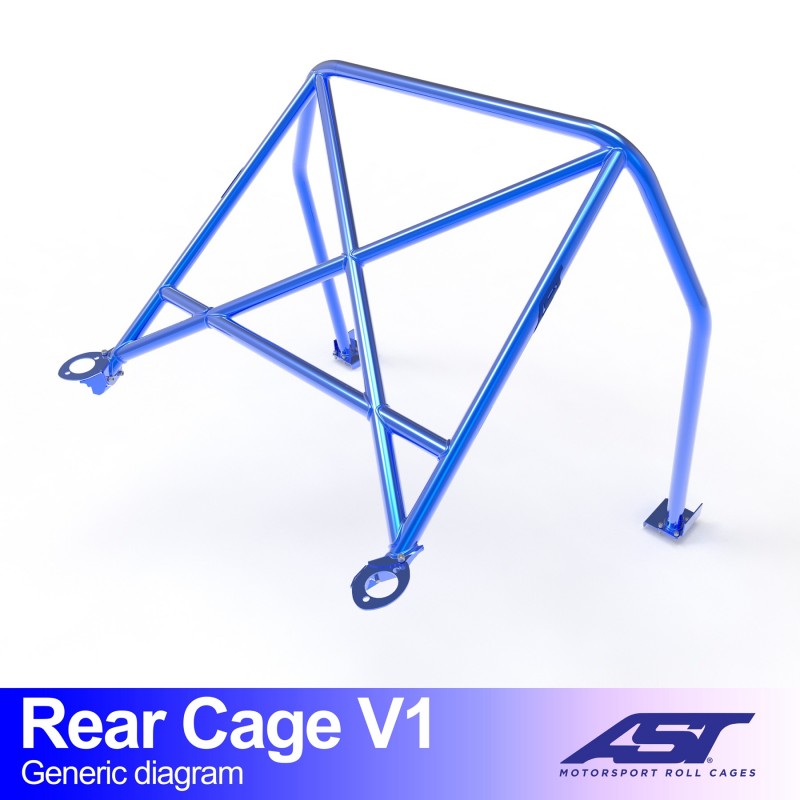
| Removable half cage | Yes | Limited, mainly at the rear | Most flexible |
| Half cage | With some work; the plates stay | Limited, mainly at the rear | Good, after checking |
| Removable full cage | Yes | At the front as well | Good, after checking |
| Bolt-in cage | Yes, via FIA connectors | At the front as well | After checking |
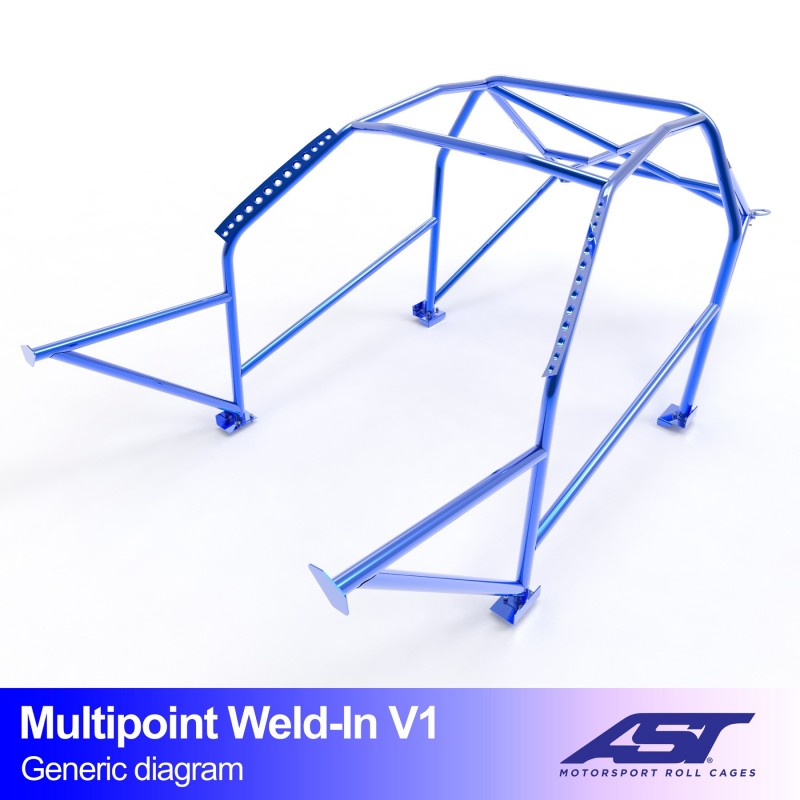
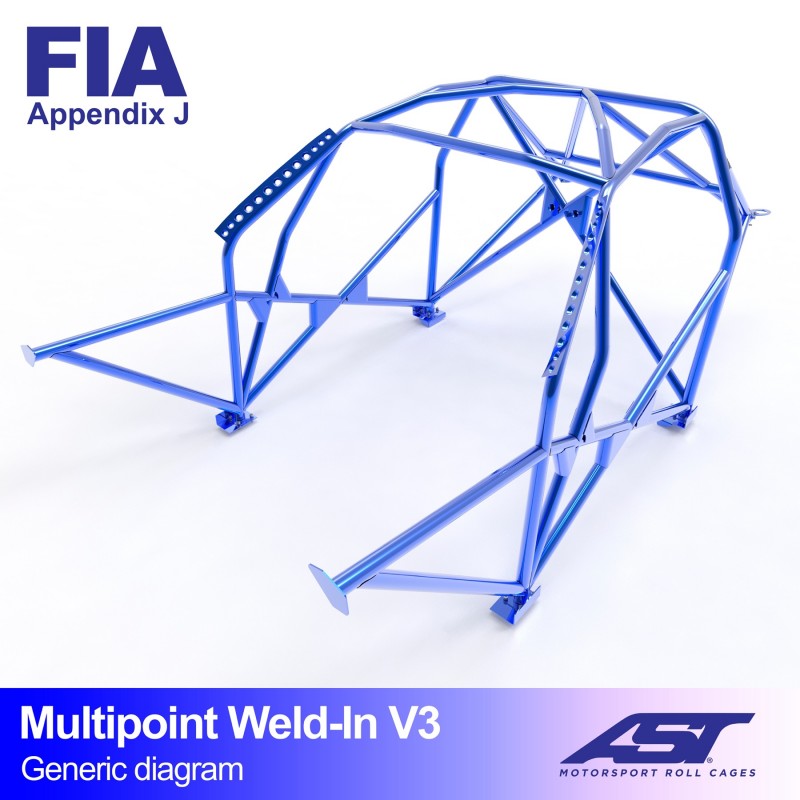
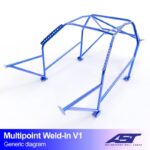
| Weld-in or multipoint cage | No | Car largely stripped | Usually intended as a competition car |
For the saloon, the AST removable half roll cage for the E36 saloon V1 is the most accessible option. For the coupé, there is the AST removable half roll cage for the E36 coupé V1. The Compact and the Touring also have their own versions: the AST removable half roll cage for the E36 Compact V1 (€739.73) and the AST removable half roll cage for the E36 Touring V1 (€739.73).
If you want to know how a bolt-in cage compares with a weld-in cage, read E36 bolt-in cage or weld-in cage: 7 differences.
Is your E36 staying road-registered? Choose a cage that can come out of the car again, so you keep your options open.
Don’t forget your insurance
Besides the APK and the vehicle inspection, there is your insurance. A roll cage is a modification to the car, and insurers generally want to know what has been changed on a vehicle. So notify your insurer that the cage has been fitted and ask them in writing how they deal with it.
If you also drive on track, check your policy terms to see whether track use is covered, and under what conditions. That is separate from the roll cage, but anyone who fits a cage usually intends to take the car on track as well.
What to take to the RDW or the inspection centre
A well-prepared conversation removes a great deal of uncertainty. When you put your question to the RDW or your inspection centre, bring as much concrete information as possible, so that the assessment is about your cage and not about roll cages in general.
- The product details of the cage: type, version, body style and mounting.
- The documentation and fitting instructions that AST supplies with the cage.
- A description or photos of how the cage is mounted, and which interior parts are removed.
- Details of the mechanic who will fit the cage.
- For Flanders: any homologation certificates or validation reports relating to your modification.
Ideally, ask for the answer in writing. An email kept with the car’s paperwork is worth its weight in gold later on if questions come up at a subsequent inspection or when you sell the car.
Returning your E36 to standard later
Plans change. Perhaps you will sell the car one day, or want to use it as a daily driver again. With a removable or bolt-in cage, you can take the cage itself out of the car again. The same applies to a half cage mounted on reinforcement plates, although the plates stay attached to the bodyshell.
With a welded-in cage, things are different: the cage has then become a permanent part of the bodyshell. If you are unsure about the car’s future, you are better off choosing a cage that can be removed again. Also keep the original interior parts you take out, so that the car can genuinely be returned to its complete original state.
When converting the car back, remember the inspection as well. In Flanders, a change to the car’s equipment should be reported, and in the Netherlands it is also wise to mention at the next APK that the cage has been removed.
Roll cage, APK and inspection: 5 rules for your E36
Sum up your preparation in these five rules:
- Rule 1: check in advance. In the Netherlands with the RDW, in Flanders with your inspection station. Do this before the cage goes in, not afterwards.
- Rule 2: choose a cage that suits your plans. If the car stays registered for the road, a removable cage is the most flexible option.
- Rule 3: finish the interior safely. Foam padding on the tubes, no sharp edges and securely mounted seats.
- Rule 4: keep all the documents. The AST documentation, the RDW’s reply or the tuning report belong with the car.
- Rule 5: report the modification to your insurer. That way you avoid disputes after a claim.
If your E36 is now only used on track and in competition, it is mainly your organiser’s regulations that apply. You can read what they require for drifting in E36 drift roll cage: what drift regulations require.
Further reading
- The complete guide to the BMW E36 roll cage
- Having an E36 roll cage fitted: checklist
- Half or full roll cage for the E36
Sources
- RDW: information about the APK (September 2026)
- RDW: approval for completion, self-build or modification (September 2026)
- GOCA Vlaanderen: tuning, basic principles and inspection (September 2026)
- RSZ Autosport: open track day regulations (September 2026)
- Product data: Race4DriftParts, 16 September 2026
Frequently asked questions
Can I drive my E36 on public roads with a roll cage fitted?
There is no simple answer. In the Netherlands we have not found any public RDW rule that deals specifically with roll cages, but a structural modification may require individual approval. In Flanders, every modification must be reported at the vehicle inspection. So check your situation in advance with the RDW or your inspection centre.
What is a tuning report in Flanders?
According to GOCA Vlaanderen, a modified car receives a tuning report after its inspection. It lists every change made to the car using non-original parts. You must always keep this report with your inspection certificate, including when you go back for inspection later.
Do I need padding on my roll cage if the car stays road-registered?
It is strongly recommended. On the road you do not wear a helmet, so your head is vulnerable if it hits a cage tube. Track day organiser RSZ Autosport already requires a protective layer of padding at head height on cars with a roll cage, and that is at least as sensible on the road.
Do I need to tell my insurer that my car has a roll cage?
Yes, declare it. A roll cage is a modification to the car, and insurers want to know what has been changed. Ask your insurer in writing how they treat the cage, and check your policy terms to see what applies if you also take the car on track.
151
Leave a Reply
You must be logged in to post a comment.

 EN
 NL
 FR
 DE