

A half cage or a full cage, and then a choice between V1 and V5: AST’s range for the E36 is extensive. This article makes the choice clear.
Short answer: Choosing between a half or full roll cage depends on what you do with your E36: a half cage stiffens the rear section, suits track days and makes a good first step, while a full cage also protects the front and is often mandatory in competition. The version number V1 to V5 refers to the tube layout, and in the shop the price rises with the version. A half cage for the E36 coupé starts at €648.66, a full cage at €1,011.07 (prices as of 16 September 2026). As an entry point, take a look at the AST half roll cage for the E36 coupé V1.
This article expands on our complete guide to the BMW E36 roll cage.
Contents
What is a half roll cage?
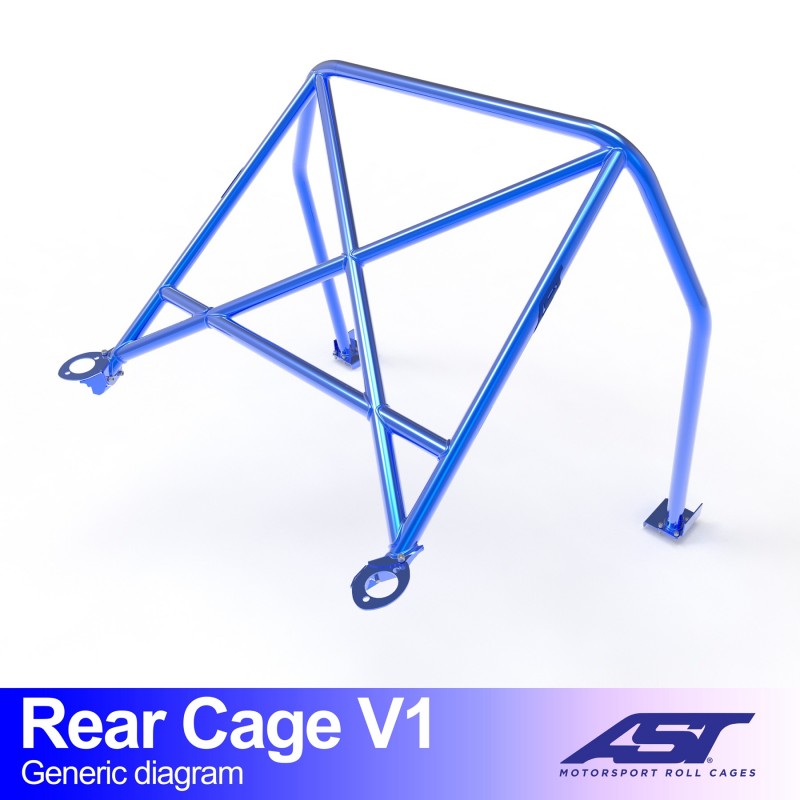
A half roll cage sits behind the front seats and stiffens the rear section of the car. You will also see it called a half cage or a rear cage. The main hoop stands behind the seats, with backstays running rearwards towards the wheel arches.
According to the product data, the AST half cage for the E36 coupé is attached to the bodyshell at four mounting points via reinforcement plates. There is also a removable version that can be taken out of the car again. In the shop it is available for the coupé, saloon, Compact and Touring, each in V1 and V2 – for example the AST removable half roll cage for the E36 Compact V2 (€882.10).
The big advantage of a half cage is accessibility. The front of the interior stays largely intact, and prices in the shop range between €648.66 and €882.10.
What is a full roll cage?
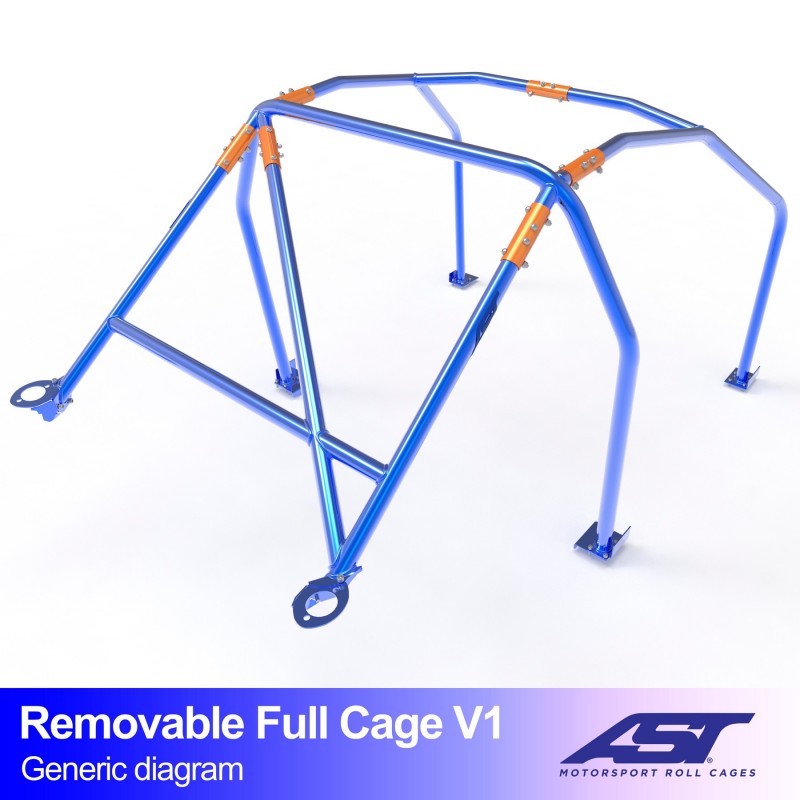
A full roll cage, or full cage, protects both the front and the rear of the cabin. Tubes run forwards along the A-pillars, so the roof above the front seats is supported as well. As a result, a full cage offers more protection in a rollover and stiffens a larger part of the bodyshell.
AST’s range for the E36 includes five types of full cage:
- The full cage with six mounting points via reinforcement plates.
- The removable full cage with bolted joints.
- The bolt-in cage with FIA connectors.
- The weld-in cage with eight welded mounting points.
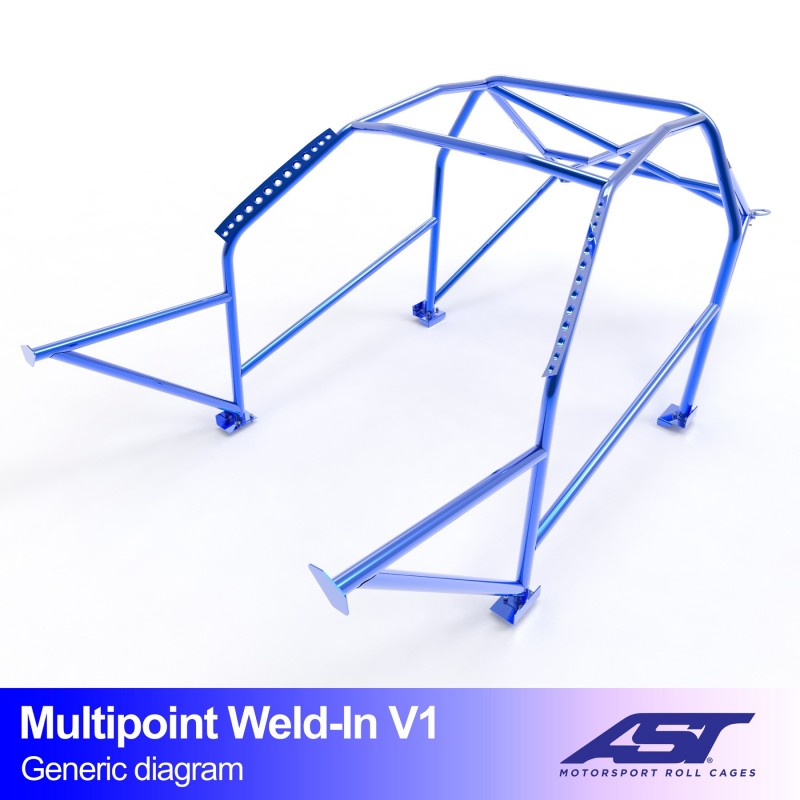
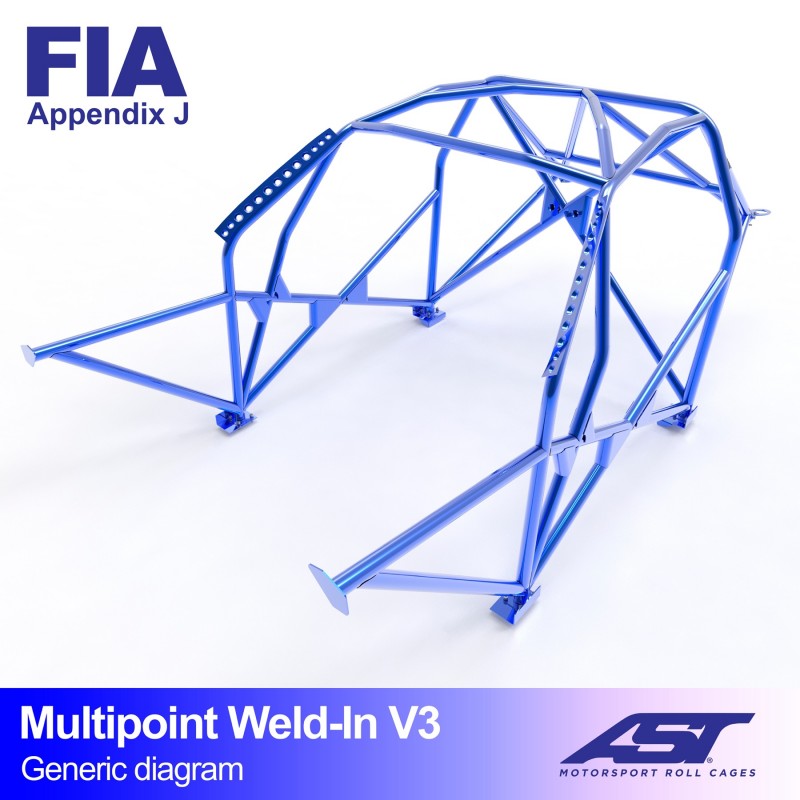
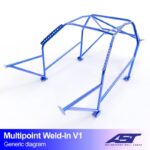
- The multipoint weld-in cage with ten welded mounting points.
You can read how these mounting methods differ in E36 bolt-in or weld-in cage: 7 differences.
Half or full roll cage: the differences
The differences between a half and a full cage are easiest to see side by side. The table uses the data for the AST cages for the E36 in the shop.
| Feature | Half cage | Full cage |
|---|---|---|
| Position in the car | Behind the front seats | Front and rear |
| Protection at the front | No | Yes, via tubes along the A-pillars |
| Mounting (AST) | 4 points, also removable | 6, 8 or 10 points |
| Front interior | Largely intact | Modifications needed |
| Versions in the shop | V1 and V2 | V1 to V5, depending on type |
| Price in the shop (E36) | €648.66 to €882.10 | €935.39 to €2,073.06 |
| Typical use | Track days, a first step | Competition, drifting, serious track use |
What stands out is that the cheapest full cage in the shop, the weld-in cage V1 at €935.39, doesn’t cost much more than the most expensive half cage. Fitting a weld-in cage does involve far more work, though, so don’t compare the price of the cage alone.
When is a half cage enough?
A half cage is enough if you mainly do track days or drift days and your organiser’s regulations don’t require a full cage. It is also a good choice if your car is staying road-registered and you want to keep the front interior.
If you’re unsure, look at your plans for the next two years. The Dutch Drift League’s regulations make a roll cage mandatory, naming both the bolt-in cage and the weld-in cage. Whether a half cage meets that requirement is something to check in the current regulations or with the organisers. You can read more about drift regulations in E36 drift roll cage: what the regulations require.
If you do track days, pay attention to the organiser’s requirements. RSZ Autosport, for example, requires cars with a roll cage to have protective foam padding on the cage tube at head height.
When should you choose a full cage?
A full cage is the better choice if you compete, if the regulations require it, or if you want maximum protection. And if your E36 is going to become a permanent track or drift car, a full cage is the logical step.
If you want to be able to return the car to standard later, choose a removable or bolt-in version. For the coupé, one example is the AST removable roll cage for the E36 coupé V3. For the Touring, the shop lists the AST removable roll cage for the E36 Touring V3 (€1,288.11), for instance. If the car is going to become a permanent competition car, look at the weld-in and multipoint cages.
Want protection at the front and rear? The full AST cage for the E36 coupé is attached at six points and comes in three versions.
What do V1, V2, V3, V4 and V5 mean?
The version number after the name of an AST cage refers to the tube layout: each version has a different arrangement of braces and diagonals. In the shop, the price rises with the version number, which shows that a higher version is a more extensive construction.
Not every type is available in every version. This table shows which versions are in the shop, with the price of the lowest and the highest version.
| AST cage type | Versions in the shop | Price range |
|---|---|---|
| Half cage (coupé) | V1, V2 | €648.66 to €776.92 |
| Removable half cage (all four body styles) | V1, V2 | €739.73 to €882.10 |
| Full cage (coupé) | V1, V2, V3 | €1,011.07 to €1,191.91 |
| Removable full cage | coupé V2 and V3; saloon, Touring and Compact V1 to V3 | €1,098.29 to €1,288.11 |
| Bolt-in (all four body styles) | V1 to V4 | €1,134.20 to €2,073.06 |
| Weld-in (all four body styles) | V1 to V5, V4 and V5 also with NASCAR door bars | €935.39 to €1,744.72 |
| Multipoint weld-in (coupé and Compact) | V1 to V4, V3 and V4 also with NASCAR door bars | €1,170.11 to €1,864.00 |
| Multipoint weld-in (saloon and Touring) | V1 to V5, V3 to V5 also with NASCAR door bars | €1,170.11 to €1,938.39 |
How do you choose the right version?
The regulations set the minimum. AST itself points out that the FIA regularly revises the safety requirements in Appendix J, and that you should check with your federation or organiser which minimum requirements apply to your car and class. A higher version than necessary is not a problem; a lower one is.
Then look at the product photos of each version. They show which additional tubes the cage has, such as diagonals in the main hoop or extra braces running forwards. Also ask your mechanic how those tubes affect getting in and out of the car and the position of the seat and belts.
What is a NASCAR version?
The weld-in and multipoint cages are also available in versions with NASCAR door bars. These have a tube at door height that bows outwards, giving more room and extra side protection. Because that tube takes up the space of the door card, the door has to be modified to accommodate it.
Removable or fixed?
Besides half or full, there is one more choice to make: should the cage be able to come out of the car again? For both the half cage and the full cage, the shop offers a removable version. That suits a car that stays road-registered, or one you might want to return to standard one day.
For the saloon, the AST removable half roll cage for the E36 saloon V2 is an example of a removable half cage. What this means for the APK or roadworthiness testing is explained in roll cage, APK and roadworthiness testing for your E36.
Three real-world examples
To make the choice more concrete, here are three hypothetical E36 owners, each with a different goal. They are examples, not real customers, but they show how the questions above lead to a decision.
Example 1: the track day driver with a road-registered coupé
This driver uses his E36 coupé at weekends and takes it on track a few times a year. He wants to keep the front interior, and the car has to pass the APK roadworthiness test. A removable half cage is the best fit here, such as the AST removable half roll cage for the E36 coupé V2.
Example 2: the drifter who wants to compete next season
This driver has an E36 coupé that has already been stripped and wants to compete with an organiser that makes a roll cage mandatory. The car may have to go back on the road later. A bolt-in or removable full cage provides protection front and rear here, and keeps that option open.
Example 3: the saloon that becomes a proper competition car
This owner is converting an E36 saloon into a car that will only ever be used on track. He wants the stiffest solution. A full weld-in cage or a multipoint cage for the saloon, in the version his regulations require, is then the logical choice.
Common mistakes when choosing
- Buying a half cage when next season’s regulations require a full cage.
- Choosing the highest version without considering what it means for getting in and out, the seat and the belts.
- Ordering a coupé cage for a saloon, a Compact or a Touring, or vice versa.
- Assuming a removable cage requires no welding: the reinforcement plates have to be securely attached to the bodyshell.
Checklist: choosing a half or full roll cage
Go through these questions before you order:
- What do the regulations require? Read the current version for your event or championship.
- Will the car stay road-registered? Then a removable version offers the most flexibility.
- Do you want to keep the front interior? Then a half cage is the better fit.
- Which version do you need as a minimum? Check with your organiser.
- Coupé, saloon, Compact or Touring? Always order the cage for your body style.
- Does your E36 have a sunroof? Mention it when you order.
How to prepare for the fitting afterwards is explained in Having a roll cage fitted to your E36: a 9-step checklist.
Further reading
- BMW E36 roll cage: the complete guide
- Bolt-in or weld-in cage for your E36
- A roll cage for drifting your E36
Sources
- AST Roll Cages: product information and FIA Appendix J (September 2026)
- Dutch Drift League: regulations (September 2026)
- RSZ Autosport: open track day regulations (September 2026)
- Prices, versions and product data: Race4DriftParts, 16 September 2026
Frequently asked questions
What is the difference between a rear cage and a half roll cage?
There is no difference: rear cage, half cage and half roll cage are simply different names for the same type of cage. It sits behind the front seats and stiffens the rear section of the car. The AST half cage for the E36 coupé is attached to the bodyshell at four mounting points via reinforcement plates.
Can I extend a half roll cage into a full cage later?
Don’t count on it. AST cages are designed per type and version, and a half cage is not made as a basis for a full cage. If you know you will want to compete later on, go for a full cage straight away, so you don’t end up buying a cage and having it fitted twice.
Which AST version is best for my E36?
The best version is the one that at least meets your regulations and suits the way you use the car. A higher version has a more extensive tube layout and costs more in the shop. Check with your organiser which requirements apply, and look at the product photos for each version before you choose.
Is the bolt-in roll cage also available for the E36 saloon?
Yes. The shop lists the AST bolt-in cage for the E36 coupé, saloon, Touring and Compact, each in versions V1 to V4. Only the fixed half cage and the fixed full cage are available exclusively for the coupé. Always order the version listed for your body style.
170
Leave a Reply
You must be logged in to post a comment.


 EN
 NL
 FR
 DE