


A roll cage is only as good as its installation. This nine-step checklist helps you sort out everything that needs doing beforehand, so your mechanic can get straight to work.
Short answer: If you want to have a roll cage fitted in your E36, sort out five things first: the regulations the cage must comply with, the right body style and version, the sunroof and headlining, a mechanic with roll cage experience, and a schedule built around the delivery time of 15 to 35 working days. After that come stripping the interior, the painting and the finishing work. Still unsure about the type? Start with the AST removable roll cage for the E36 coupé V2 or read our guide first.
This article is part of our complete guide to the BMW E36 roll cage, where you will find every AST type for the E36 along with its shop price.
Table of contents
Why preparation matters so much when fitting a roll cage
Installing a roll cage is not a job you squeeze in between other tasks. AST states for its cages that the interior needs to be modified, or that parts such as the dashboard, door cards, trim and rear seats have to come out. The better you sort this out in advance, the more smoothly the installation goes and the fewer surprises you will face.
Good preparation also prevents the most expensive mistake of all: a cage that does not suit your body style, your sunroof or your regulations. Because AST cages are tailored to each order, sending one back is not a simple option. So take your time working through the steps below.
Step 1: decide what you will use the cage for
The first step is not a screwdriver but a document: the regulations. Do you take part in track days, drift events or sanctioned competitions? Every organiser has its own requirements, and the KNAF points out that roll cage requirements differ from one discipline to another.
Write down what you do now and what you want to be doing within two years. If you buy a half cage today and start competing next year, you may still end up needing a full cage. For drifting, you will find the details in E36 drift roll cage: what drift regulations require.
Step 2: choose the right body style and version
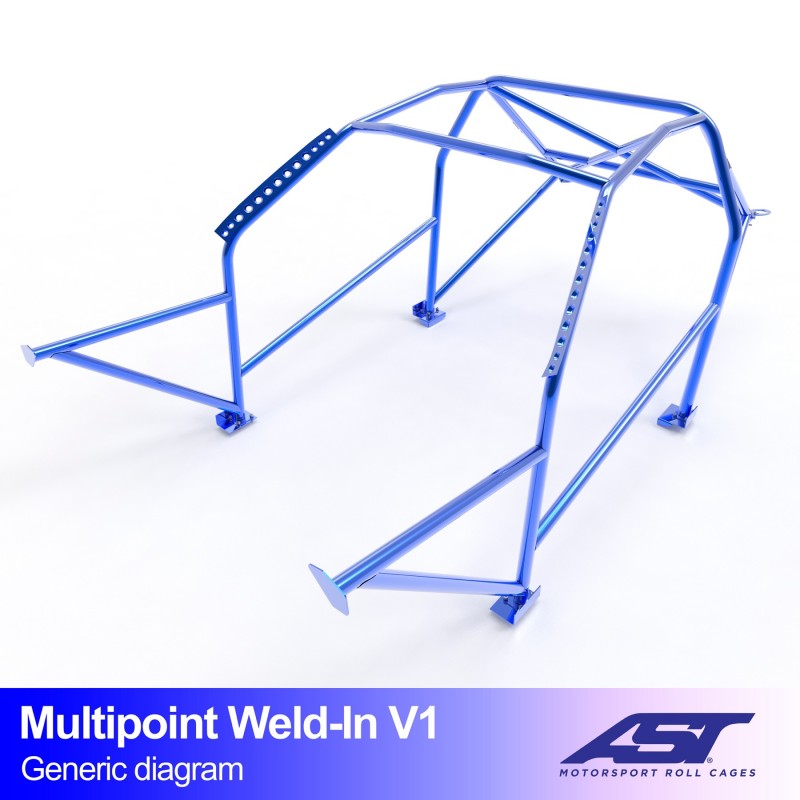
A cage for the E36 coupé will not fit the saloon, the Compact or the Touring. AST designs its cages for each body style on the basis of a 3D laser scan of that specific bodyshell, and every product in the shop states which version it is intended for. For the Compact, for example, there is the AST multipoint weld-in roll cage for the E36 Compact V1 (€1,170.11), and for the Touring the AST bolt-in roll cage for the E36 Touring V3 (€1,894.78).
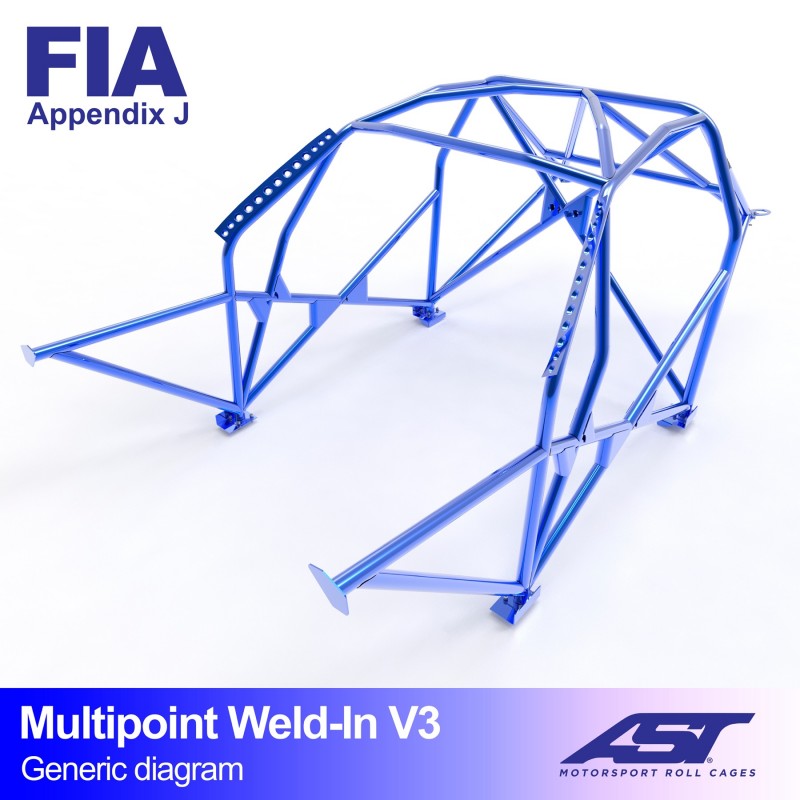
Then choose the type and version. The difference between a bolt-in and a weld-in cage is explained in E36 bolt-in or weld-in roll cage: 7 differences. The difference between half and full cages, and between V1 and V5, is covered in half or full roll cage for the E36.
Step 3: specify your sunroof and headlining
Does your E36 have a sunroof, or is the headlining still in place? Mention this when you order. For the half cages, the removable cages and the bolt-in cages, the product details state that the cage is tailored to this.
This is no minor detail. A cage sits as close to the roof as possible to leave room for your head. A few millimetres’ difference caused by a sunroof frame or headlining then decides whether a cage fits or not.
Step 4: plan around the delivery time
All AST cages for the E36 are listed in the shop with a delivery time of 15 to 35 working days. Add your mechanic’s schedule and any paintwork, and you can easily be looking at several months between placing the order and your first drive.
If you want the car ready for the new season, order in winter and only agree an installation date once the delivery date is known. That way your car will not sit stripped for weeks, waiting.
Want to be ready in time for the season? Order your cage well in advance, so your installation does not have to wait for delivery.
Step 5: choose a mechanic with roll cage experience
The mechanic makes all the difference. For the AST weld-in cages, the product details state explicitly that installation must be carried out by a mechanic experienced with roll cages. For bolt-in and removable cages, a specialist fitter is recommended.
Ask your mechanic these questions:
- How many roll cages have you installed so far, and in which cars?
- Can I see photos of your previous roll cage welding work?
- How do you check the welds and the fit of the reinforcement plates?
- Which interior parts have to come out for this type of cage?
- Do you have experience with the regulations of my discipline?
If you compete in sanctioned events, also check the KNAF’s list of approved roll cage manufacturers. According to the KNAF, these companies are first checked on several points, and each approval is valid for one year.
Step 6: strip the interior
Which parts have to come out depends on the type of cage. For its cages, AST lists the dashboard, door cards, trim and rear seats as parts that need to be modified or removed.
- Half cage: mainly the rear of the interior, such as the rear seats and side trim.
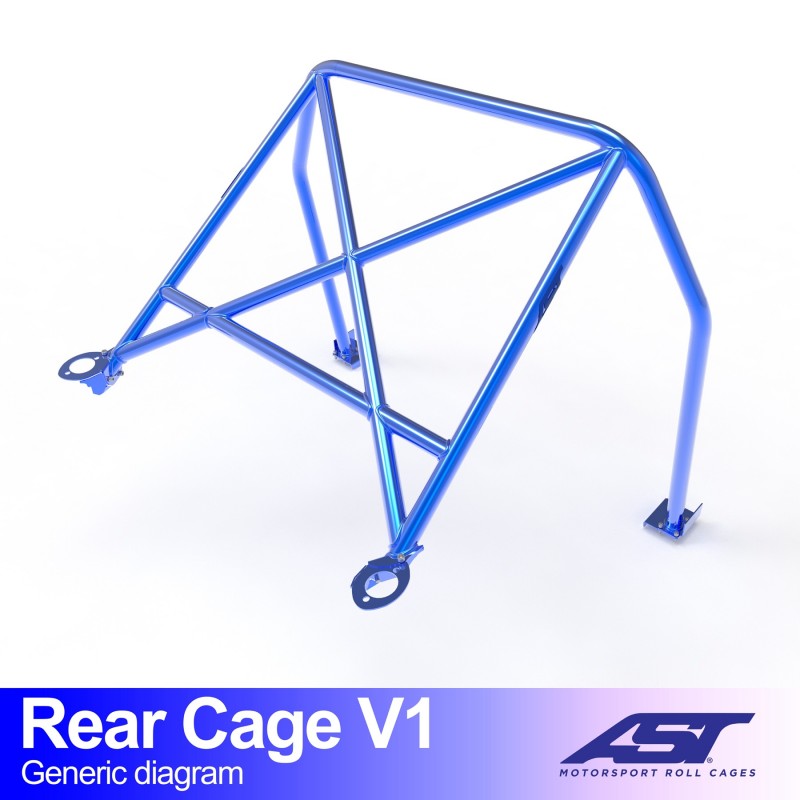
- Full bolt-in cage: the front as well, because tubes run along the A-pillars.
- Weld-in cage: in practice an empty car, so the welder can reach everywhere and there is no fire risk from trim or insulation.
Work tidily: photograph cables and connectors, bag and label the bolts, and store everything somewhere dry. If you ever want to put the car back to standard, you will be glad you did.
Step 7: check the bodyshell
Every E36 is now 25 years old or more. So check the floor, the sills and the areas where the reinforcement plates will go. Rust or old repairs in those spots must be put right first, otherwise your cage will rest on a weak foundation.
Have your mechanic look for previous accident damage too. If a bodyshell has ever been pulled out of true, you will notice it when fitting a cage designed from a 3D scan of a straight bodyshell.
Step 8: plan the painting or powder coating
AST supplies its cages unpainted. So it is up to you whether you have the cage powder-coated, painted or given another finish. Plan this in advance, as it affects the order of the work.
With a bolt-in cage, you can trial-fit the cage first, mark the positions, take it out again and then have the interior and the cage finished separately. With a weld-in cage, the painting is usually done once the cage is in the car, which demands more precision around the tubes.
Step 9: finish the installation
A car with a cage fitted is not yet a finished car. Only when the safety equipment around the cage is right will you get the full benefit of your investment. Take your time over this, even if you are keen to get straight out on track. Round off the installation with these points:
- Foam padding on the tubes at head height. RSZ Autosport requires it at track days for cars with a roll cage, and it is a sensible choice away from the circuit too.
- Seats and harnesses that suit your use. Drift regulations often call for bucket seats and at least four-point harnesses.
- Keep the documentation. AST cages come with documentation and fitting instructions. Keep them with the car’s paperwork.
- Arrange the inspection. In Flanders, according to GOCA, you must report every modification to the inspection centre. For the Netherlands, read more in roll cage, APK and inspection for your E36.
What can you do yourself and what should you outsource?
If you are a handy home mechanic, you can easily do part of the work yourself; the rest belongs with a specialist. Splitting it this way makes your planning more realistic and avoids arguments afterwards.
Do it yourself
- Stripping out the interior and storing it carefully.
- Removing bitumen and sound deadening where work will be carried out, if your mechanic asks you to.
- Delivering the car clean and dry, with an empty boot.
- Fitting the foam padding, seats and harnesses after the installation, if you have experience with this.
Outsource
- Welding the cage and the reinforcement plates.
- Repairing rust or old damage at the mounting points.
- Powder-coating or painting the cage.
- Checking the fit and the joints after installation.
Agree this split with your workshop in advance. Some mechanics prefer to strip the car themselves, because that way they know exactly what has been removed. Others are perfectly happy for you to do the preparatory work.
After the first few drives: check everything
A new cage deserves an inspection after the first few drives. On a bolt-in cage, check that the bolts and connectors are still tight, and listen out for any noises or vibrations that weren’t there before. If in doubt, ask your mechanic to take a look.
With a removable or bolt-in cage, it makes sense to build that check into your regular maintenance, for example before every new season. That way the roll cage keeps doing the job you had it installed for.
Checklist: having an E36 roll cage fitted at a glance
| Step | What to arrange | When |
|---|---|---|
| 1 | Pin down the regulations and intended use | Before you order |
| 2 | Choose the body style, type and version | Before you order |
| 3 | Specify sunroof and headlining | When ordering |
| 4 | Plan around a delivery time of 15 to 35 working days | When ordering |
| 5 | Choose an experienced mechanic | Before delivery |
| 6 | Strip the interior | Before installation |
| 7 | Check and repair the bodyshell | Before installation |
| 8 | Schedule painting or powder coating | Before or during installation |
| 9 | Padding, seats, harnesses, paperwork, inspection | After installation |
Common installation mistakes
These mistakes cost time and money, and the checklist above helps you avoid them:
- Ordering the cage for the wrong body style.
- Failing to specify the sunroof or headlining.
- Stripping the interior before the delivery date is known.
- Leaving rust on the mounting points.
- Not fitting padding to the tubes around the driver’s head.
Once the preparation is done, you can make your choice. For a permanent competition car based on the saloon, the AST weld-in roll cage for the E36 saloon V2 is the logical step, and for a Touring the AST weld-in roll cage for the E36 Touring V2 (€1,173.96).
Further reading
- BMW E36 roll cage: every AST type and the best choice
- Bolt-in or weld-in cage for your E36
- Roll cages and the APK or vehicle inspection
Sources
- AST Roll Cages: scope of delivery and interior modifications (September 2026)
- AST Roll Cages: 3D scanning and reinforcement plates (September 2026)
- KNAF: approved roll cage manufacturers (September 2026)
- RSZ Autosport: open track day regulations (September 2026)
- GOCA Vlaanderen: tuning and vehicle inspection (September 2026)
- Delivery times and product data: Race4DriftParts, 16 September 2026
Frequently asked questions
Which interior parts have to come out for an E36 roll cage?
For its cages, AST lists the dashboard, door cards, trim and rear seats as parts that have to be modified or removed. With a half cage, it is mainly the rear section of the interior that is affected. With a weld-in cage, the car is in practice stripped completely bare. Discuss with your mechanic what really needs to come out for your type of cage.
Will an AST roll cage fit if my E36 has a sunroof?
Mention the sunroof when you place your order. For the half cages, the removable cages and the bolt-in cages, the product details state that the cage is tailored to a sunroof and to the presence of headlining. The cage sits close to the roof, so this information is needed for a proper fit.
Should I have the roll cage powder-coated?
That is up to you. AST supplies its cages unpainted, so you can have them powder-coated or sprayed in a colour of your choice. A finish protects the steel against rust. Plan it in advance: with a bolt-in cage you can finish the cage separately, whereas with a weld-in cage it is usually done once the cage is in the car.
How long will my E36 be off the road while a roll cage is installed?
That depends on the type of cage, the condition of the bodyshell and your mechanic’s schedule. On top of that, allow for the delivery time of 15 to 35 working days. If you only strip the car once the delivery date is known, you limit the time your E36 sits unusable in the workshop.
53
Leave a Reply
You must be logged in to post a comment.

 EN
EN NL
NL FR
FR DE
DE