

Torn between a bolt-in cage and a weld-in cage for your E36? This article gives an honest side-by-side comparison of stiffness, installation, regulations and price.
Short answer: The choice between an E36 bolt-in cage or weld-in cage comes down to one question: will the cage ever need to come out of the car again? A weld-in cage (standard weld-in or multipoint) is stiffer and suits a dedicated competition car, while a bolt-in cage (removable or bolt-in version) can be taken out and requires less invasive work on the interior. In our shop, the AST weld-in roll cage for the E36 starts at €935.39 and the AST bolt-in for the E36 coupé at €1,134.20 (prices as of 16 September 2026). As a starting point, take a look at the AST bolt-in roll cage for the E36 coupé V1.
This article is part of our complete guide to the BMW E36 roll cage, which compares all six AST types for the E36 side by side.
Table of contents
What is the difference between a bolt-in cage and a weld-in cage?
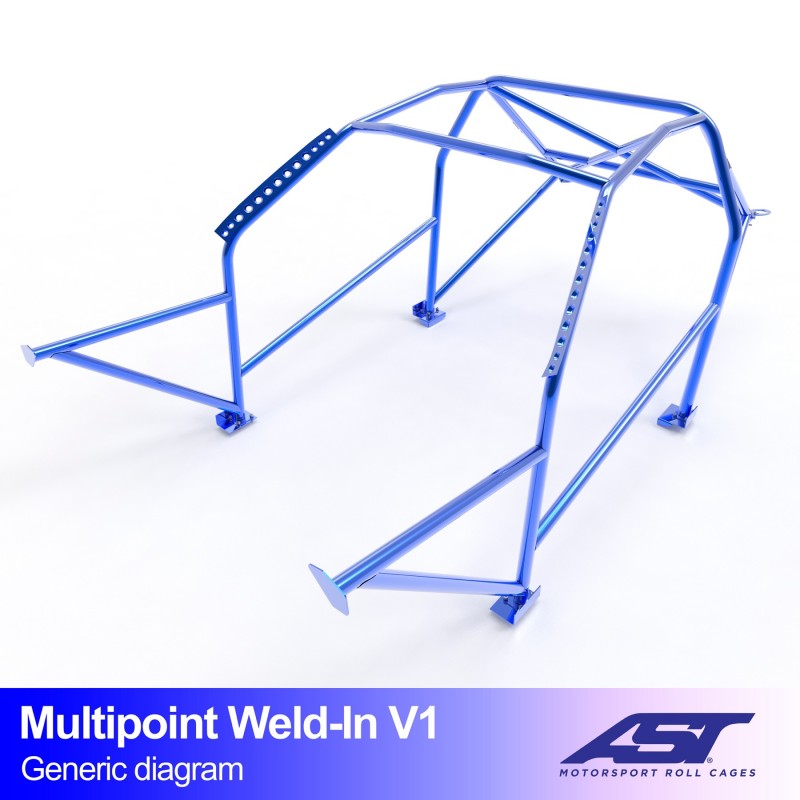
The difference lies in how the cage is joined to itself and to the bodyshell. With a weld-in cage, every tube is welded to the others and to the bodyshell. The cage becomes one with the body of your E36 and cannot be removed again without an angle grinder.
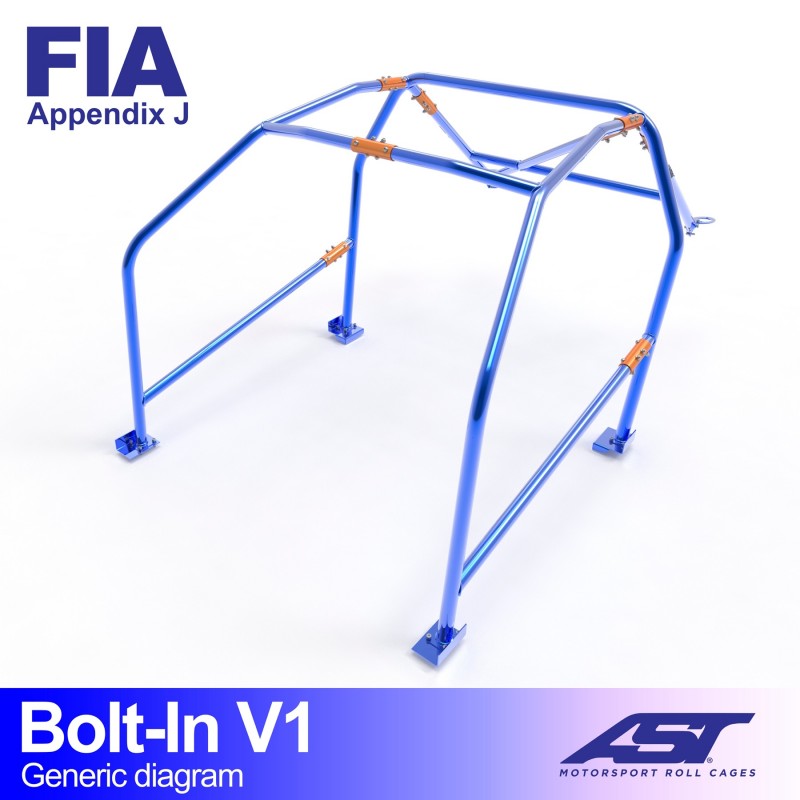
With a bolt-in cage, the parts are joined with bolts or connectors. The cage comes in sections, so you can get the parts through the door opening, and it sits on reinforcement plates fixed to the bodyshell. Because the joints can be undone, the cage can be taken out of the car again later.
In the AST range for the E36, the types break down as follows:
- Bolt-in cages: the removable half cage, the removable full cage and the bolt-in cage with FIA connectors.
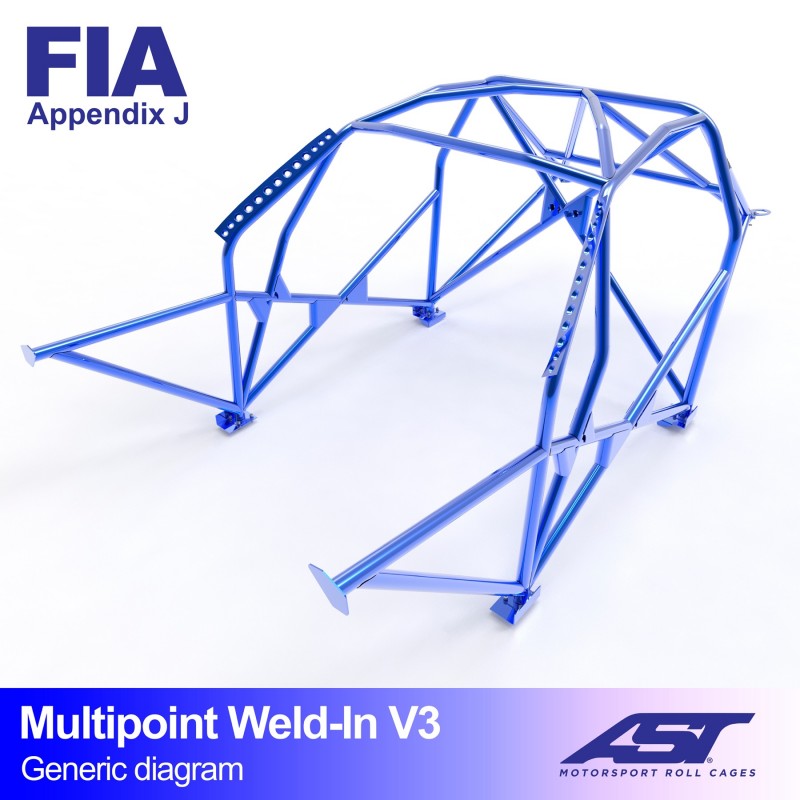
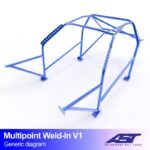
- Weld-in cages: the weld-in cage with 8 welded mounting points and the multipoint weld-in cage with 10 welded mounting points.
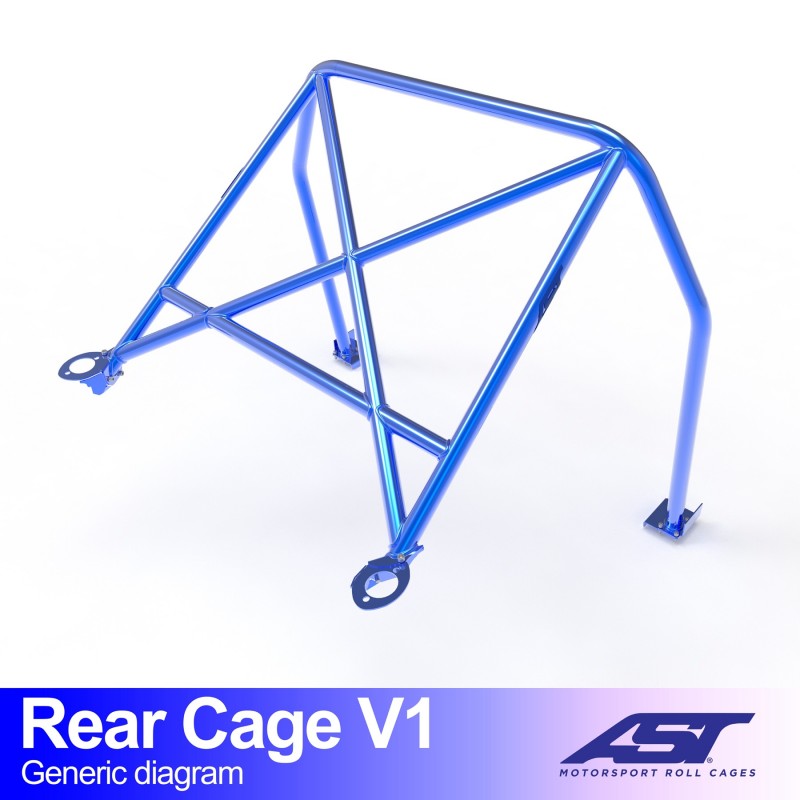
- In between: the half cage and the full cage, which are attached to the bodyshell at four or six points via reinforcement plates.
Which is stiffer and safer?
A weld-in cage is stiffer than a bolt-in cage. That is also the conclusion that keeps coming up in Dutch-language explanations and on forums: fixed joints have less play than bolted joints, and a weld-in cage is usually attached to the bodyshell at more points.
With AST, you can see this in the figures. The bolt-in cage for the E36 coupé is fixed at 6 points, the weld-in cage at 8 and the multipoint at 10. More mounting points mean that forces are spread more evenly across the bodyshell, both in an accident and during the normal twisting of the body through a corner.
Safety is about more than stiffness alone, though. A properly fitted bolt-in cage with the right tube layout offers far more protection than a poorly welded cage. The quality of the installation matters at least as much as the type.
Can you feel the difference when driving?
In a drift car or track car, you will notice that a stiffer bodyshell responds more predictably. Your suspension then does more of the work, instead of the body flexing along with it. On forums, some drivers say that a very stiff car also feels different and that you adjust your setup accordingly. That is a matter of taste and setup, not a reason to do without a cage.
Can a bolt-in cage be fitted without welding?
No, don’t count on it. A bolt-in cage also sits on reinforcement plates, and these have to be firmly attached to the bodyshell. The AST bolt-in cage comes with reinforcement plates made from 3 mm thick steel, and the product information asks for the installation to be carried out by a specialist fitter.
So the advantage of a bolt-in cage is not “no welding”, but what it makes possible afterwards: the cage can come out of the car again, and the car usually needs less stripping for the installation than with a weld-in cage.
What preparation does a weld-in cage require?
A weld-in cage requires the most preparation. AST supplies the weld-in and multipoint cages as a weld-in kit: the tubes are pre-bent and made to fit, but are welded together inside the car. The delivery also includes a T-joint weld sample, mounting hardware, documentation and fitting instructions.
According to AST, these cages require interior parts such as the dashboard, door cards, trim and rear seats to be modified or removed. With a weld-in cage, the interior is usually stripped completely, so that the welder can reach everywhere and there is no fire risk from trim or insulation.
Painting is another consideration. Forums rightly point out that a car with a bolt-in cage is easier to paint inside: fit the cage, mark the positions, remove the cage, paint. With a weld-in cage, you have to work around the tubes.
You can read about the full preparation in the article Having an E36 roll cage installed: a 9-step checklist.
What do the regulations say about bolt-in and weld-in cages?
The regulations of your competition or organising body also have a say. The KNAF notes that roll cage requirements differ from one discipline to another, and that on 1 January 2021 the FIA changed the rules for so-called self-built cages. Anyone building a car for sanctioned competition should therefore read those rules beforehand.
The drift scene is often more relaxed. The Dutch Drift League states that a roll cage has been compulsory since 2022 and that either a bolt-in or a weld-in cage is allowed. For exactly what each organisation’s regulations require, read E36 drift roll cage: what drift regulations really require.
AST builds its cages to FIA Appendix J, but itself points out that you should check with your federation or organiser which minimum requirements apply to your car and class.
E36 bolt-in or weld-in cage: the 7 differences at a glance
Compare an E36 bolt-in cage with a weld-in cage and the differences boil down to seven points. The table uses the data for the AST cages for the E36 in the shop.
| Difference | Bolt-in cage (removable or bolt-in) | Weld-in cage (standard or multipoint) |
|---|---|---|
| Mounting | Bolts, screw joints or FIA connectors on reinforcement plates | Permanently welded |
| Number of mounting points (AST) | 4 to 6 | 8 or 10 |
| Stiffness | Good | Highest |
| Removing it later | Possible | Not without an angle grinder |
| Interior | Modifications needed, less invasive | Car largely stripped |
| Delivery | Welded in sections | Weld-in kit, to be welded together in the car |
| Price in the shop (E36) | €739.73 to €2,073.06 | €935.39 to €1,938.39 |
Worth noting: in the shop, a bolt-in cage is not necessarily cheaper than a weld-in cage. The bolt-in cage for the coupé in V4 costs €2,073.06, whereas a weld-in cage for the coupé in V1 costs €935.39. A weld-in cage does take more work to fit, though, and that comes with its own price tag, which varies from one workshop to the next.
Going for maximum stiffness? A welded-in cage with 8 welded mounting points is the foundation of a genuine competition E36.
Which cage suits the way you use your car?
The right choice follows from how you use your E36. These rules of thumb will point you in the right direction:
- The car stays road-registered and occasionally goes on track: a removable cage, so you stay flexible. For the saloon, there is the AST removable roll cage for the E36 saloon V1.
- Drift events, with competition on the cards: a bolt-in cage, strong yet still removable.
- The car is becoming a dedicated competition car: a weld-in cage, preferably multipoint. For the saloon, that is the AST multipoint weld-in roll cage for the E36 saloon V2.
- Budget first, starting out with track days: a half cage. Whether that is enough is covered in half or full roll cage for the E36.
What if you want to switch later?
If you start with a bolt-in cage and later want a weld-in one, in practice you will be buying a new cage. “Welding up” a removable cage after the fact does not change the fact that its tube layout and mounting points were never designed for a weld-in cage. So it is better to choose the type that suits your end goal right from the start.
Common misconceptions
When choosing between a bolt-in and a weld-in cage, the same misconceptions keep cropping up:
- “A bolt-in cage is a project with no welding.” The reinforcement plates still have to be firmly attached to the bodyshell.
- “A weld-in cage is always more expensive.” In the shop, the most expensive AST cage for the E36 is a bolt-in.
- “More tubes is always better.” How the tubes join up with one another and how well they are fitted matter at least as much.
- “I’ll read the regulations later.” A cage that does not comply will cost you your start – or a new cage.
Five questions to help you choose
Five honest answers will tell you which way to go. Work through them before you order a cage, ideally together with the mechanic who will be doing the fitting.
1. Will your E36 stay road-registered?
If the car will still be driven on public roads, flexibility counts for a lot. A cage that can come out of the car again gives you room to manoeuvre if the rules or your plans change. In that case, also read what the APK and vehicle inspection rules for roll cages mean for your E36.
2. Do you want to compete within two years?
Then the regulations of those competitions are your most important guide. Buy a light cage now and need a heavier one a year later, and you pay twice. So look at your end goal, not just at your first season.
3. How far do you want to strip the interior?
A weld-in cage needs an empty car. If you want to keep as much of the dashboard, door cards and trim as possible, a bolt-in cage is a better fit for your plans. Discuss with your mechanic which parts really have to come out for the type you choose.
4. Which body style do you drive?
The E36 comes in four body styles: coupé, saloon, Compact and Touring. The bolt-in cage and the removable full cage are listed in the shop for all four, for example the AST bolt-in roll cage for the E36 Touring V2 (€1,680.59) and the AST removable roll cage for the E36 Compact V1 (€1,098.29). The fixed half cage and full cage are only available for the coupé. Because AST designs every cage for a specific body style, always order the version for your bodyshell.
5. Who will fit the cage?
A good mechanic makes more of a difference than the type of cage. Ask up front about their experience with roll cages, for examples of previous work and about how the welding is checked. Only once that question has been answered is your choice between an E36 bolt-in cage and a weld-in cage truly complete.
Further reading
- BMW E36 roll cage: the complete guide
- Preparing for a roll cage installation
- A roll cage for drifting in your E36
Sources
- AST Roll Cages: E36 coupé Weld In V4, scope of supply and interior modifications (September 2026)
- KNAF: roll cages and home-built cages since 2021 (September 2026)
- Dutch Drift League: regulations (September 2026)
- Prices and product data: Race4DriftParts, 16 September 2026
Frequently asked questions
Can I remove a bolt-in roll cage from my E36 later?
Yes. A bolt-in cage is fitted in sections using FIA connectors, so it can be taken out of the car again. The reinforcement plates, however, remain attached to the bodyshell. If you want to return the E36 fully to standard, expect extra work on the floor and interior where the plates were fitted.
Is a weld-in cage mandatory for drift competitions?
Not always. The Dutch Drift League states in its regulations that a roll cage is mandatory and that both bolt-in and weld-in cages are permitted. Other organisations may have stricter requirements. So always read the current regulations of the event or championship you want to enter before choosing a cage.
Why is a multipoint weld-in cage stiffer than a standard weld-in cage?
A multipoint cage is connected to the bodyshell at more points. At AST, the standard weld-in cage for the E36 has eight welded mounting points and the multipoint version ten. These extra connections spread forces more evenly across the bodyshell, making the body stiffer in corners and in an impact.
Can I weld up a bolt-in cage later to turn it into a weld-in cage?
That will not give you a true weld-in cage. The tube layout and mounting points of a removable cage are not designed for a weld-in cage, and regulations may treat the modification as an alteration to the cage. If you know the car is going to become a competition car, choose a weld-in or multipoint cage from the outset.
69
Leave a Reply
You must be logged in to post a comment.

 EN
EN NL
NL FR
FR DE
DE